Fugaku, the world’s fastest computer, is researching the spread of Covid-19
TOPSHOT - This picture taken on June 16, 2020 shows Japan's Fugaku supercomputer at the Riken Center for Computational Science in Kobe, Hyogo prefecture. - The Fugaku supercomputer, built with government backing and used in the fight against the COVID-19 coronavirus, is now ranked as the world's fastest, its developers announced on June 22, 2020. (Photo by STR / JIJI PRESS / AFP) / Japan OUT (Photo by STR/JIJI PRESS/AFP via Getty Images)
For the first time in years, Japan has the fastest supercomputer in the world and it’s being used to research the spread and treatment of the novel coronavirus.
Fugaku, which was developed by Fujitsu (FJTSF) and government research institute Riken, ranked first in the Top500 list of global supercomputers, Fujitsu and Riken announced on Tuesday. It marks the first time a Japanese system has taken the top slot since 2011.
The Top500 measures benchmarks such as processing speed and the performance of computing used in artificial intelligence and deep learning.
Fugaku can perform more than 415 quadrillion (or 415,000 trillion) computations a second, making it 2.8 times faster than Summit, the supercomputer built by IBM (IBM) which previously held the top spot.
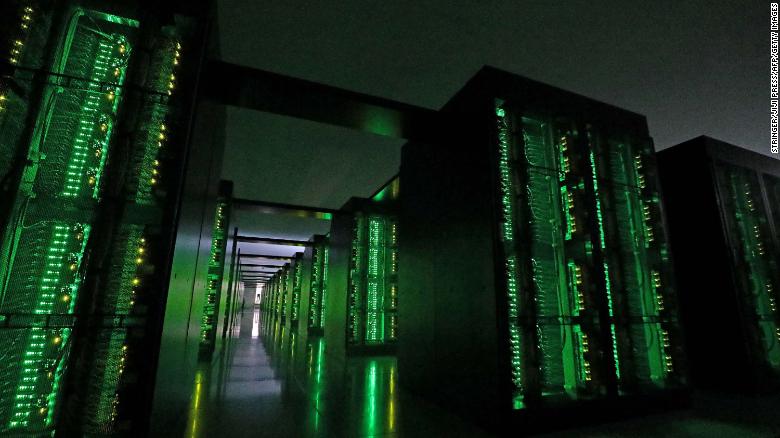
Fugaku, the fastest supercomputer in the world, is being used to research the spread and treatment of Covid-19.
The leading-edge technology developed for Fugaku will hopefully “contribute to major advances on difficult social challenges such as Covid-19,” Satoshi Matsuoka, director of the Riken Center for Computational Science, said in a statement.
The Japanese supercomputer is already being used on an experimental basis for research on Covid-19, including on diagnostics, therapeutics, and simulations of the spread of the virus, Riken said in a statement in April. Fugaku — which is another name for Mount Fuji — is scheduled to be operating at full capacity next year.
Powered by chips from SoftBank-owned (SFTBY SOFTBANK) Arm, the Japanese supercomputer knocked Summit intosecond place. Sierra, another US-built system, took third place, and two supercomputers developed by Chinese national research institutes, Sunway TaihuLight and Tianhe-2A, rounded out the top five.
Used to distinguish new sessions and visits. This cookie is set when the GA.js javascript library is loaded and there is no existing __utmb cookie. The cookie is updated every time data is sent to the Google Analytics server.
30 minutes after last activity
__utmc
Used only with old Urchin versions of Google Analytics and not with GA.js. Was used to distinguish between new sessions and visits at the end of a session.
End of session (browser)
__utmz
Contains information about the traffic source or campaign that directed user to the website. The cookie is set when the GA.js javascript is loaded and updated when data is sent to the Google Anaytics server
6 months after last activity
__utmv
Contains custom information set by the web developer via the _setCustomVar method in Google Analytics. This cookie is updated every time new data is sent to the Google Analytics server.
2 years after last activity
__utmx
Used to determine whether a user is included in an A / B or Multivariate test.
18 months
_ga
ID used to identify users
2 years
_gali
Used by Google Analytics to determine which links on a page are being clicked
30 seconds
_ga_
ID used to identify users
2 years
_gid
ID used to identify users for 24 hours after last activity
24 hours
_gat
Used to monitor number of Google Analytics server requests when using Google Tag Manager
1 minute
__utma
ID used to identify users and sessions
2 years after last activity
__utmt
Used to monitor number of Google Analytics server requests
10 minutes
_gac_
Contains information related to marketing campaigns of the user. These are shared with Google AdWords / Google Ads when the Google Ads and Google Analytics accounts are linked together.