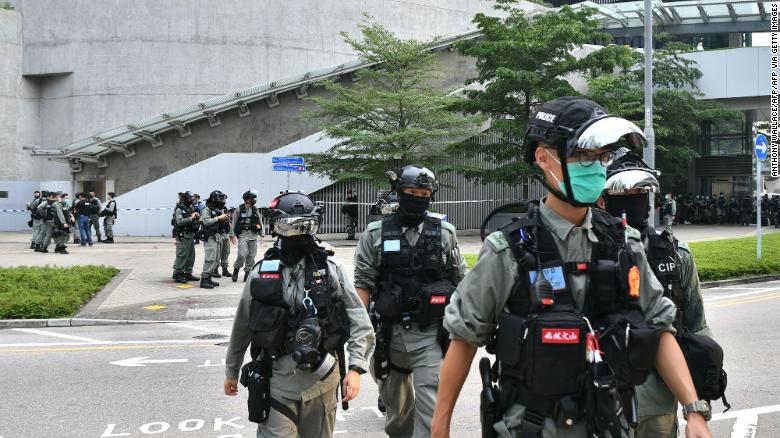
A heavy police presence could be seen in downtown Hong Kong Wednesday, as lawmakers in the semi-autonomous Chinese city prepare to debate a hugely controversial national anthem bill.
Protesters had announced plans to try and surround the city’s Legislative Council and potentially block the second reading of the bill going ahead, but as staff at the complex arrived Wednesday, they seemed to have come to nothing. Hundreds of riot police were standing guard on roads and bridges leading to building, and could be seeing stopping and searching people for blocks around the area and in the local subway station.
Lawmakers are due to begin discussion of the national anthem law, which will make it a crime punishable by up to three years in prison “to insult” China’s national anthem, “March of the Volunteers,” during Wednesday’ legislative session.
Last year, a similar debate over the extradition bill with China was successfully blocked when protesters swarmed roads around the Legislative Council complex, preventing lawmakers from entering the building and occupying the area for several hours before they were forced away by police tear gas and rubber bullets.
In a statement late Tuesday, police warned that anyone attempting the same Wednesday could face up to five years in prison. “Resolute enforcement actions will be taken,” the statement said. “Offenders will be arrested and any vehicles that caused serious obstruction will be swiftly towed away.”
Wednesday’s debate is happening in the shadow of newly proposed national security and anti-sedition laws for Hong Kong, which Beijing announced last week it will impose directly on the city, bypassing the local legislature, via a rarely-enacted constitutional backdoor.
The law has been widely denounced in both Hong Kong and internationally, with observers warning it could curtail many of the political freedoms and civil liberties guaranteed in the agreement handing the city over from British to Chinese rule in 1997.
More than 200 parliamentarians and and policymakers from two dozen countries signed an open letter last week slamming the anti-sedition bill as a “comprehensive assault on the city’s autonomy, rule of law, and fundamental freedoms.”
One of the leading signatories of that letter, Chris Patten, the last colonial governor of Hong Kong, told CNN that “the Communist party of China which has broken its word about so many international agreements, is driving a coach and horses through the international agreement that it reached with Britain: a treaty lodged with the United Nations, to safeguard Hong Kong’s high degree of autonomy, its rule of law and its freedom for 50 years after 1997. And it’s simply tearing that agreement up.”
For its part, Beijing argues the law is necessary to prevent the kind of violent unrest seen last year during protests over the extradition bill. Chinese authorities blamed “foreign forces” for encouraging or leading those protests, and said that the lack of national security legislation made Hong Kong a “loophole” in the country’s defenses.
Later this month, the United States Congress is due to decide whether Hong Kong remains sufficiently autonomous from mainland China to justify continuing its special trading privileges. US Secretary of State Mike Pompeo said the proposed anti-sedition bill would “inevitably impact our assessment,” and other lawmakers have suggested imposing sanctions against Beijing and Hong Kong officials responsible for the move.
Speaking at the White House Tuesday, spokeswoman Kayleigh McEnany said that US President Donald Trump “said to me that he’s displeased with China’s efforts and that it’s hard to see how Hong Kong can remain a financial hub if China takes over.”
In a reply to reporters questions later, Trump himself said “we’re doing something now.”
“I think you’ll find it very interesting, but I won’t be talking about it today, I’ll be talking about it over the next couple of days,” he said. Pressed later, Trump said the announcement was coming, “before the end of the week.”
Credit: Source link